HealthInsight
Corporate health-checkup sessions, participant records, clinical interpretation, and individual or company reports in one hospital workflow.
Verified production footprint
Aggregate snapshot verified 29 August 2026
- production deployments
- 3
- participant profiles
- 35,801
- examination encounters
- 69,471
- report records
- 81,770
- structured data points
- 2.84M
Operational volume only. These figures do not claim a causal clinical or efficiency outcome.
Context
Workplace health checkups produce participant details, laboratory and examination results, individual recommendations, and population-level summaries. The same programme needs both a clinically reviewable individual record and a group view suitable for planning and surveillance.
Problem
When collection, interpretation, and reporting live in separate files, teams spend time matching records and rebuilding summaries. Inconsistent structures also make it harder to compare groups or explain how an individual interpretation was produced.
My role
I defined the health-data workflow, clinical interpretation direction, role-specific information architecture, reporting needs, and full-stack implementation.
What was built
- Structured collection of workplace checkup data.
- Automated individual interpretation prepared for professional review.
- Separation between source results, interpretation, and recommendation.
- Group analysis for programme planning and surveillance.
- Reports for clinical and operational teams.
Design story
Follow a checkup from preparation to report
The current public introduction uses four stages: create a session, prepare participants, record and review findings, and generate reports. This gives the hospital team a familiar sequence before introducing specialist examination features.
Keep interpretation connected to its source
Individual findings, previous checkups, and the hospital's interpretation rules belong to the review process. Reports are the next output of that process. The design keeps the person reviewing results in view instead of presenting an automated interpretation as a final clinical conclusion.
Key workflow
- Collect the checkup data in a consistent structure.
- Validate the source results and participant context.
- Generate an individual interpretation for professional review.
- Correct or confirm the result without losing the source values.
- Aggregate appropriate variables for group analysis and reporting.
Constraints
Health data requires strict access boundaries and careful handling of identifiers, exports, and support requests. Automated interpretation must remain visibly reviewable rather than being presented as an unquestionable diagnosis.
Verified operational footprint
The snapshot verified on 29 August 2026 covers three production deployments: 35,801 participant profiles, 69,471 health examination encounters, 81,770 report records, and approximately 2.84 million structured data points. These describe operational scale, not causal evidence of clinical or efficiency outcomes.
Implementation recorded in the original case study
Front end: Blazor WebAssembly. Back end: ASP.NET Core (.NET 6), PostgreSQL and Entity Framework Core.
These implementation details are retained from the original case study; this content refresh does not establish the application's current package versions.
Image and source notes
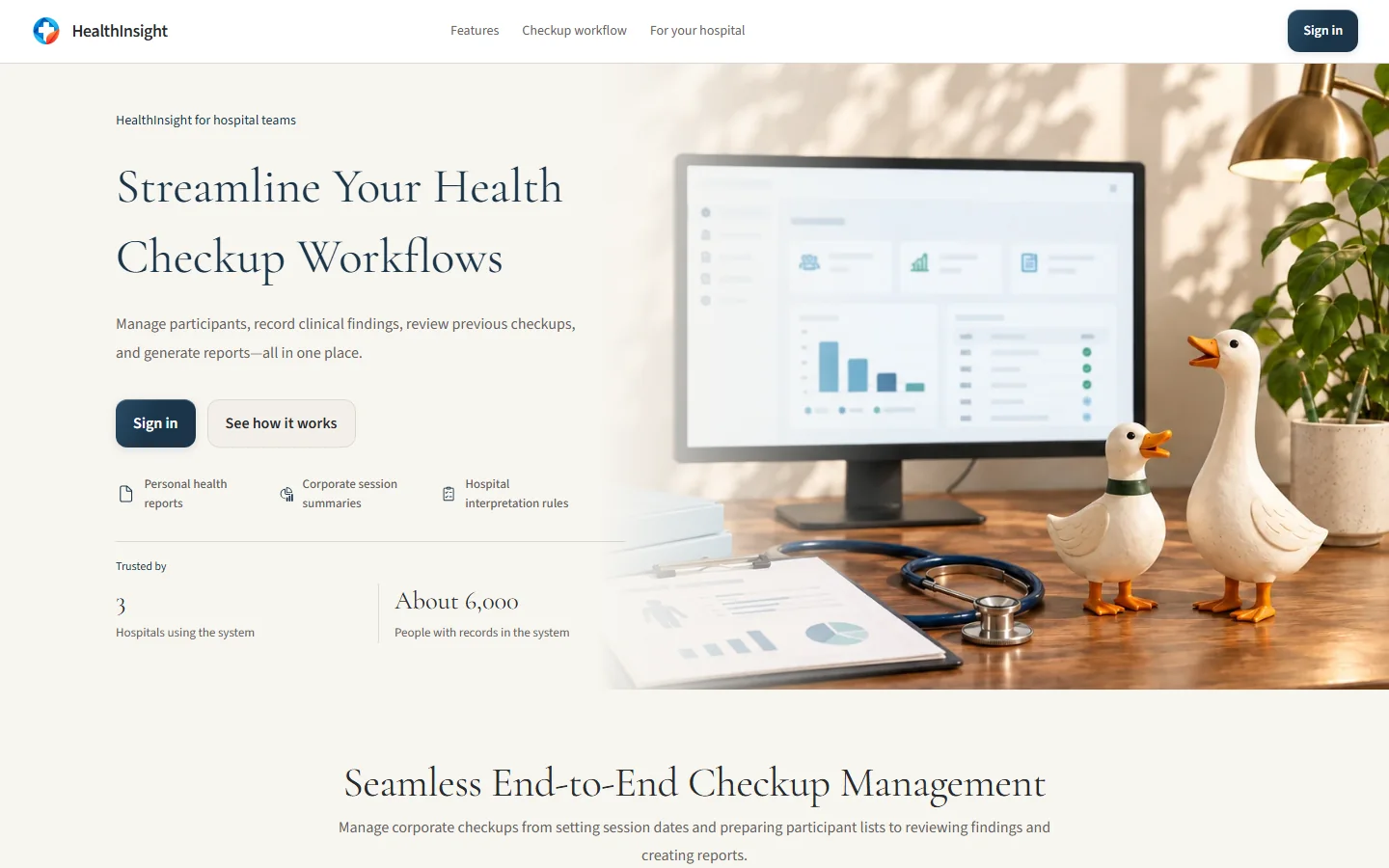
Public landing page, October 2026. The monitor is introductory artwork; no participant records are shown. Usage figures visible in the source page are not newly verified metrics in this case study.
Content refreshed on 7 November 2026 from the published Quack & Honk HealthInsight page.